
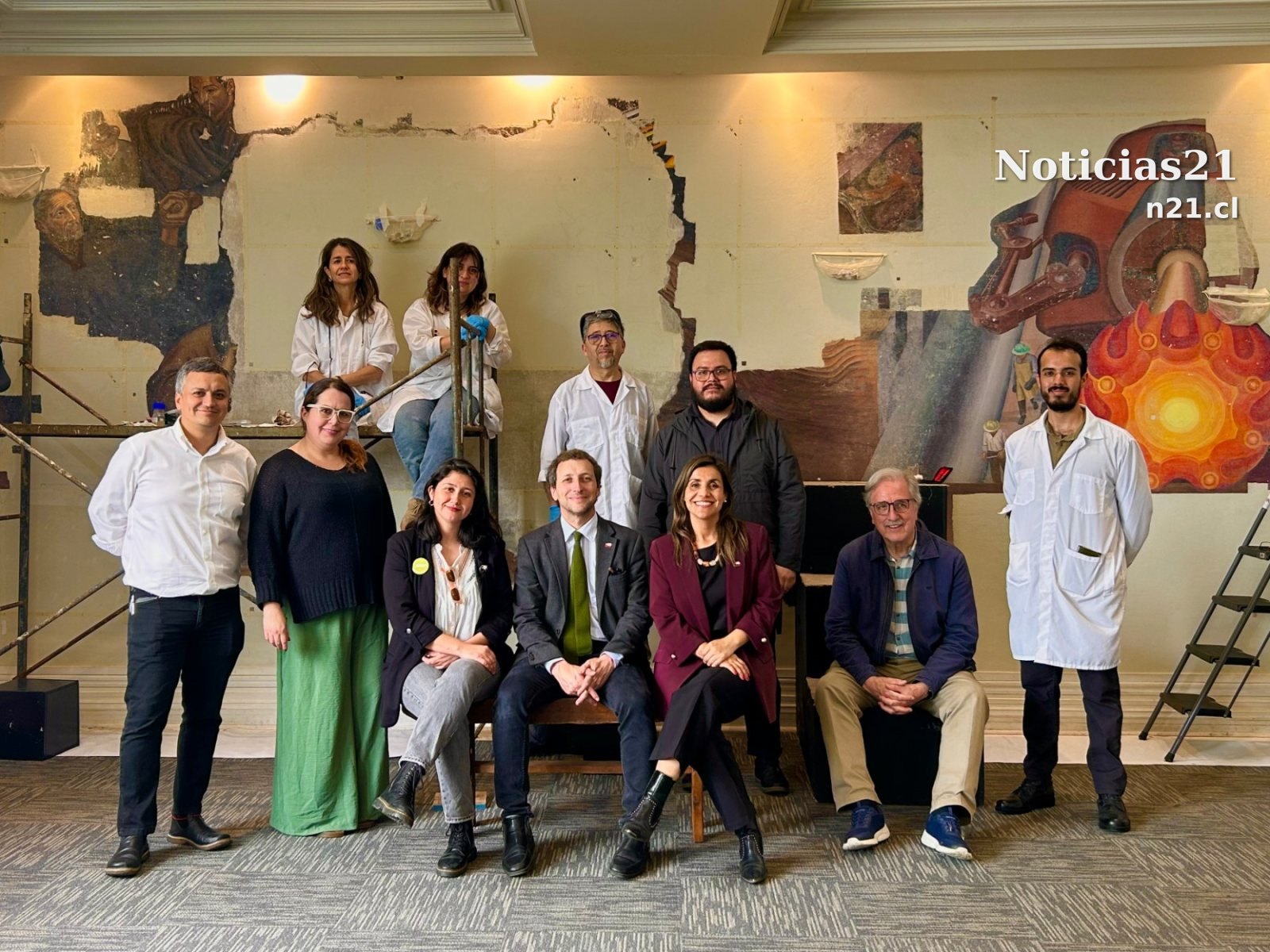
Chillán’s artistic heritage is beginning to recover one of its most significant works. The murals Principio y Fin (Beginning and End), created by renowned Chilean artist Julio Escámez, are undergoing restoration at the Chillán Municipal Government Building.
During a visit to the restoration site, Undersecretary for Cultural Heritage Emilio de la Cerda highlighted the artistic importance of Escámez and the need to preserve his legacy, regardless of the political differences associated with his public life.
"The fundamental thing is to recognize Julio Escámez’s enormous artistic value, regardless of his political position," the official stated.
The visit was also attended by Ñuble’s Regional Secretary for Culture, Arts and Heritage, Nataly de la Hoz, and the Director of the National Cultural Heritage Service, Claudio Martínez.
During the tour, professionals from the Municipality of Chillán’s Heritage Unit presented the progress of the restoration and explained the technical procedures being carried out by the specialized team to recover these works.
The restoration began in July 2026 and is funded by the Municipality of Chillán, under the coordination of its Heritage Unit.
A work shaped by history
Created between 1969 and 1971 and inaugurated in 1972, the murals Principio y Fin represent an important part of Chillán’s artistic and cultural history.
Their story is also closely connected to Chile’s social and political memory. After being censored, the murals remained hidden for nearly five decades, until their recovery process began.
Their historical and artistic significance received official recognition on August 20, 2025, when the murals were declared National Monuments in the Historic Monument category through a decree published in Chile’s Official Gazette.
Chillán Mayor Camilo Benavente acknowledged the work of the professionals involved and expressed his hope that the public will soon be able to appreciate the murals in all their restored splendor.
The restoration represents an opportunity to recover an important part of the city's artistic memory and introduce new generations to the legacy of Julio Escámez.